 |
Celeritas 0.7.0-3+develop.835656ac1
|
Loading...
Searching...
No Matches
|
Celeritas 0.7.0-3+develop.835656ac1
|
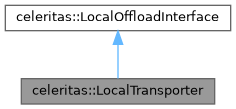
Manage offloading of tracks to Celeritas. More...
#include <LocalTransporter.hh>
Public Member Functions | |
| LocalTransporter (SetupOptions const &options, SharedParams ¶ms) | |
| Construct with shared (MT) params. | |
| void | Push (G4Track &) final |
| Convert a Geant4 track and add it to the Stepper producer buffer. | |
| CoreStateInterface const & | GetState () const |
| Access core state data for user diagnostics. | |
| CoreStateInterface & | GetState () |
| Access core state data for user diagnostics. | |
| operator bool () const | |
| Whether the class instance is initialized. | |
LocalOffload interface | |
| void | Initialize (SetupOptions const &options, SharedParams ¶ms) final |
| Helper for making initialization more obvious from user code. | |
| void | InitializeEvent (int) final |
| Set the event ID and reseed the Celeritas RNG at the start of an event. | |
| void | Flush () final |
| Transport all buffered tracks and produced secondaries. | |
| void | Finalize () final |
| Clear local data. | |
| bool | Initialized () const final |
| Helper for making initialization more obvious from user code. | |
| size_type | GetBufferSize () const final |
| Number of accepted primaries not yet accounted as transported. | |
| MapStrDbl | GetActionTime () const final |
| Get the accumulated action times. | |
 Public Member Functions inherited from celeritas::LocalOffloadInterface Public Member Functions inherited from celeritas::LocalOffloadInterface | |
| operator bool () const | |
| Whether the class instance is initialized. | |
Additional Inherited Members | |
| Public Types inherited from celeritas::LocalOffloadInterface | |
| using | MapStrDbl = std::unordered_map< std::string, double > |
| Protected Member Functions inherited from celeritas::LocalOffloadInterface | |
| LocalOffloadInterface (LocalOffloadInterface const &)=default | |
| LocalOffloadInterface & | operator= (LocalOffloadInterface const &)=default |
| LocalOffloadInterface (LocalOffloadInterface &&)=default | |
| LocalOffloadInterface & | operator= (LocalOffloadInterface &&)=default |
Manage offloading of tracks to Celeritas.
This class must be constructed locally on each worker thread/task/stream, usually as a shared pointer that's accessible to:
Stepper owns two fixed-capacity host primary buffers and the device event that protects the source of an asynchronous H2D copy. LocalTransporter validates and converts Geant4 tracks, pushes accepted primaries into the Stepper producer buffer, and keeps the corresponding Geant4 energy and loss accounting. Primaries outside the Celeritas geometry are counted as lost but are not added to either Stepper buffer.
When the producer buffer first reaches capacity, Push stages it and immediately calls StepperInterface::async. Same-stream ordering ensures that the primary-copy completes before the stepping kernels use it. The Stepper retains the staged host storage until the copy completes, while Geant4 can continue filling the second buffer.
At most one step result, one staged batch, and one producer batch can be pending. Before reusing a full producer buffer, Push submits any staged batch. It then applies backpressure by consuming and advancing the current result only until start-of-step initialization can consume enough queued tracks and primaries to preserve room for the secondary stack. Active tail tracks may remain when a new batch is staged and launched. Calls to stage_primaries and async can still block on synchronization internal to the current Stepper implementation. Before accepting each subsequent track, Push polls a pending step. If it is ready, its result is consumed and another step is launched whenever existing transport remains or another batch is staged. This allows device transport to progress while Geant4 continues producing primaries. A full producer batch is staged only when it fits alongside queued initializers and leaves the maximum usable initializer capacity for secondaries after vacant track slots have been filled.
At event end, Flush first submits any staged batch. If a partially filled producer buffer remains, it advances the current transport until that batch satisfies the same initializer and secondary-capacity admission rule, then stages and launches the producer batch. It finally steps all transport synchronously to completion. Selection and compaction of device-generated Geant SD data are enqueued on the device during the action launch, so a step is not ready until they complete. The compacted data is copied to the host and reconstructed only when the completed step result is consumed, keeping the host copy and hit processing out of the asynchronous action launch. The current copy still synchronizes before the next step starts. Hit processing and Geant4 track reconstruction are kept alive across the asynchronous work and cleared only after the drain completes. A flush with only rejected primaries still reports and clears their loss accounting.
Host mode has the same buffering interface but no asynchronous overlap: a full producer buffer calls Flush and is transported to completion before Push returns.
LocalTransporter accounting follows the Stepper primary lifecycle:
| State | Stepper state | Local accounting |
|---|---|---|
| Producer | Primaries accepted by push_primary | buffered_accum_ |
| Staged | H2D copy queued; actions not submitted | staged_accum_ |
| Submitted | Batch submitted by async | in_flight_accum_ |
| Accounted | First result for batch consumed | Added to run_accum_ |
in_flight_accum_ is cleared when the first result for its submitted batch is consumed, even if the resulting active tracks require additional steps. GetBufferSize returns accepted primaries that have not yet reached this accounting point. It does not count rejected primaries, active Celeritas tracks, or generated secondaries. The transport_active_ flag records whether the last consumed result requires another step, while valid on the Stepper records a currently pending result. The step iteration count spans all overlapping primary batches and resets only after transport becomes empty. Calling Finalize requires both states to be idle, normally by first calling Flush.
|
finalvirtual |
Clear local data.
This may need to be executed on the same thread it was created in order to safely deallocate some Geant4 objects under the hood...
Implements celeritas::LocalOffloadInterface.
|
finalvirtual |
Transport all buffered tracks and produced secondaries.
Implements celeritas::LocalOffloadInterface.
|
finalvirtual |
Get the accumulated action times.
Implements celeritas::LocalOffloadInterface.
|
finalvirtual |
Number of accepted primaries not yet accounted as transported.
Implements celeritas::LocalOffloadInterface.
|
inlinefinalvirtual |
Helper for making initialization more obvious from user code.
This gives it some symmetry with Finalize, which is provided as an exception-friendly destructor.
Implements celeritas::LocalOffloadInterface.
|
inlinefinalvirtual |
Helper for making initialization more obvious from user code.
This gives it some symmetry with Finalize, which is provided as an exception-friendly destructor.
Implements celeritas::LocalOffloadInterface.
Set the event ID and reseed the Celeritas RNG at the start of an event.
Implements celeritas::LocalOffloadInterface.
Convert a Geant4 track and add it to the Stepper producer buffer.
Implements celeritas::TrackOffloadInterface.
 1.9.8
1.9.8